Reshaping the public discourse
Identifying and naming invisible injustices is the first step to correcting them. CWJ’s educational initiatives foster an active, educated public that can be mobilized to agitate for the change Israeli society needs most.
In the media, in Knesset hearings, through educational programming, and in the streets--CWJ is reshaping the public discourse surrounding women's rights in Israel.
A Blight Unto the Nations: The Decline and Fall of the Chief Rabbinate, with Rachel Stomel
An overlooked part of the judicial overhaul has been the proposed changes to Israel’s State Rabbinate. Spoiler: It ain’t pretty.
In this episode of the Orthodox Conundrum Podcast with Scott Kahn, CWJ’s Rachel Stomel unravels such mysteries as: What does the Turkish Sultan have to do with Jewish law? How does Israel’s entanglement of religion and state compromise the integrity of both? What are the implications of a bill that would centralize rabbinic authority and limit halachic expression? What was so fishy about a recently-passed law delaying the selection of the next Chief Rabbis?
What Matters Now to women’s justice lawyer Susan Weiss: The rise of theocracy
Buses, bigotry, and… Barbie?
Times of Israel’s “What Matters Now” podcast with Amanda Borschel-Dan hosts CWJ executive director Susan Weiss to hash out the rising trend of public gender segregation, the judicial overhaul, agunot, the Supreme Court, and yes, the Barbie movie. (Transcript in link)
Dr. Susan Weiss: Five areas in which the override clause should terrify women
The Times of Israel’s podcast miniseries, Israel’s Judiciary: Reform or Ruin? takes a nuanced journey into looming legislation that could alter country’s checks and balances. In this episode, Amanda Borschel-Dan speaks with CWJ’s Susan Weiss about how the proposed High Court override clause may affect women’s rights.
Domestic Violence is an Orthodox Problem: A Conversation with Rachel Stomel
When we talk about addressing violence against women, we often bring up resources like women’s shelters, emergency hotlines, or ways to identify abusive partners. But the conversation cannot stop there.
“There is a fire raging all around us and we are instructing women how to operate a fire extinguisher,” says CWJ’s Rachel Stomel to Scott Kahn in this episode of the Orthodox Conundrum Podcast. “We are completely ignoring the structural violence against women, all of these systems that are built into our culture, into our law, into halacha, all of these things around us that reinforce and perpetuate–and sometimes, even create–violence against women.”
Is Israel a Democracy or Theocracy? A Conversation with Susan Weiss
Is Israel a democracy or a theocracy? The very question might raise some eyebrows, and that’s why it’s so critical that we examine this contradiction at the heart of Israel’s entanglement of religion and state. Listen to CWJ’s executive director Susan Weiss hash it out with Daniel Gordis on his podcast, Israel from the Inside.
Mamzerut: A Legitimate Problem that is Not Going Away
Mamzerut—the stigma branded onto children of biblically forbidden unions—is one of the most misunderstood issues in Judaism today. This is largely due to the huge taboo surrounding it. Nobody talks about it. Let’s change that.
The Orthodox Conundrum Podcast hosts CWJ’s Rivkah Lubitch, Israel’s foremost advocate on behalf of those branded as mamzerim, to do a deep dive into the unexpected ways the mamzer problem plays out today, correct misconceptions (pun intended), and talk about what we can do about it.
Can Feminism and Orthodoxy Coexist? with Rachel Stomel
Chochmat Nashim co-founder Rachel Stomel guest stars in this podcast with Shoshanna Keats-Jaskoll and Anne Gordon to ask: Can feminism and Orthodoxy coexist? They discuss the controversial closure of an Israeli Facebook group—which had spawned a popular movement—dedicated to Orthodox feminism, and the questions it raises for the two ideologies that often find themselves at odds with each other.
Demystifying Jewish Divorce
In this fascinating episode of Vibe of the Tribe, a podcast by Jewish Boston, hosts Miriam Anzovin and Kali Foxman demystify Jewish divorce as well as the complex attitudes toward it. They ask special guest, CWJ’s founder Susan Weiss: Do you think it is possible to resolve the agunah problem within halacha?
“Yes and no. Any social construct is socially reconstructable. That said, the notion that God said that only men can give a get makes it hard to reconstruct. These are ways that language and ideology and discourse work to keep power relations in place.”
LISTEN: Demystifying Jewish Divorce
David Ze'ev in Israel: Susan Weiss and Eli Ovits
When a woman starting a Haredi political party tries to put an ad in a Haredi newspaper, what happens? David Jablinowitz speaks to Susan Weiss, executive director of the Center for Women’s Justice, about its lawsuit against two ultra-Orthodox newspapers for refusing to print an ad for Ruth Colian, founder of U’Bezchutan, Israel’s first Haredi women’s political party. When, if ever, do religious considerations override anti-discrimination laws?
CWJ's Impact Fighting for Women's Rights in Israel
#RuthReactions and Taking Action: CWJ & Miriam Anzovin
The 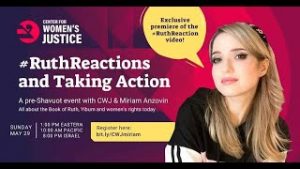 Center for Women’s Justice and Miriam Anzovin’s pre-Shavuot event all about the Book of Ruth, how it connects to the practice of yibum and how these laws affect women today.
Featuring:
- Exclusive premiere of Miriam’s #RuthReactions video
- CWJ Rabbinic Court Advocate Rivkah Lubitch on the laws of yibum and chalitza, with real stories of modern-day cases
- CWJ’s Rachel Stomel on practical solutions for women today
Conference on Mamzer Status in Israel in Conjunction with the Israel Democracy Institute
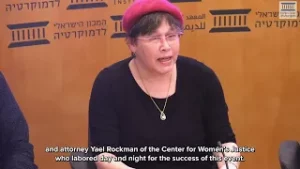 VIDEO SERIES: How does Israel’s laws on mamzer status affect the lives of children, mothers and fathers from both civil and religious perspectives? In a conference that was the first of its kind, CWJ’s Tears of the Oppressed Forum, in conjunction with the Israel Democracy institute, explored Israel’s mamzer problem with a focus on practical civil solutions.
Is Israel a Democracy or a Theocracy? Lunch & Learn
 CWJ Lunch & Learn, hosted by Stephanie Garry and Avra Gordis
In honor of International Women’s Day, CWJ’s executive director Dr. Susan Weiss holds a robust conversation on the interface between religion and state in Israel and how that impacts women’s rights.
Analysis from the Legal Battlefield: Israeli Courts vs. Converts, Mamzerim, Adulterous Women and Immigrants
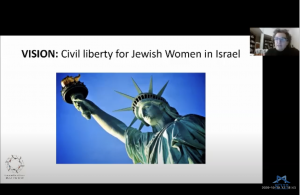 Hosted by Hiddush
In this webinar, CWJ’s executive director Dr. Susan Weiss lays out the way Israel’s entanglement of religion and state has created a partial theocracy that violates women’s rights. Susan reveals how the state conducts inquisition-like investigations into the Jewish status of converts and immigrants while probing the private lives of women in search of “suspected adulteresses” and mamzerim–illegitimate children.
Mikveh and Corona: An Interactive Discussion
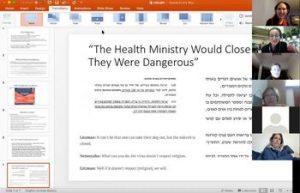
CWJ hosts rabbinic student Shayna Kovler for an interactive discussion about mikveh during the corona pandemic.
How can we know if Israeli mikvaot are following the recommended hygiene protocols? What is the state’s role in ensuring that its own institutions–the Ministry of Religious Affairs, which operates the state mikvaot–follow the law? From a halakhic perspective, are there any alternative solutions that ensure both our safety and our religious needs, or are those things fundamentally at odds?
Should Israel Allow Public Gender Segregation?
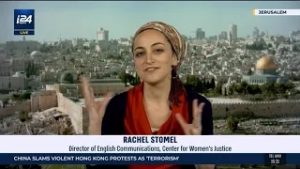 A recent court decision prevented the municipality of the Israeli town of Afula from segregating a concert intended for the Ultra-Orthodox community. Should state-enforced segregation be legal if a community chooses it? Rachel Stomel of the Center for Women’s Justice discusses the legal ramifications on i24 News.
Savta Bikorta
 Savta Bikorta (“Grandma Critic”) is a series of satirical video clips in the style of children’s storytelling. The videos tell the story of real rulings issued by the the State Rabbinic Courts in Israel.
Created in 2009, the series remains relevant to this day.
Position Papers
CWJ’s position papers succinctly outline, define and propose solutions for the problems at the heart of Israel’s violations of women’s rights in the name of religion. Our position papers help lawmakers, leaders, activists and the public understand the scope of complicated issues, equipping them with the knowledge to approach solutions from an informed perspective.
Position paper on Mamzer Status in Israel
Israel stigmatizes mamzerim–children born of biblically forbidden unions–and denies them legal rights. In this position paper, CWJ’s Tears of the Oppressed Forum elucidates the harms that the state inflicts on people affected by mamzer status and presents holistic solutions in both the civil and religious arenas.
Position paper on the Bill to Expand Jurisdiction of Israel's Rabbinic Courts Internationally
A proposed law would give Israel’s rabbinic courts international jurisdiction over foreign divorce cases, including those of non-Israeli citizens who do not live in Israel. Claiming that this measure would help them free agunot (women in marital captivity) by allowing them to apply sanctions on non-Israeli get refusers, the law would essentially redefine nationality based on Jewish ethnicity rather than on Israeli citizenship. This expansion of power would take Israel’s current civil liberties violations arising from religion-state entanglement and replicate them abroad. CWJ outlines the fundamental injustice of this bill and how it poses a risk to Jewish women.
Position paper on the Nation State Law
A clause in Israel’s proposed Nation State Law would legalize discrimination against minorities, women and marginalized groups in the name of “multiculturalism”. CWJ’s position paper sounded the alarm by outlining how this language of “conserving tradition” undermines important rights. Ultimately, this clause was stricken from the final version of the law.
Position paper on the Rabbinic Courts Arbitration Bill
A proposed law would expand the jurisdiction of the State Rabbinic Courts to act as arbitrators in civil matters, whereby they would be able to rule in accordance with Din Torah–Jewish Law–rather than the laws of the state. This would mean that the state would fund and operate courts of law that employ only male judges and male legal advisors, and which apply Hareidi religious doctrine that considerably limits women’s rights and opportunities. CWJ’s position paper demonstrates how this would especially harm women and marginalized members of society.
Knesset
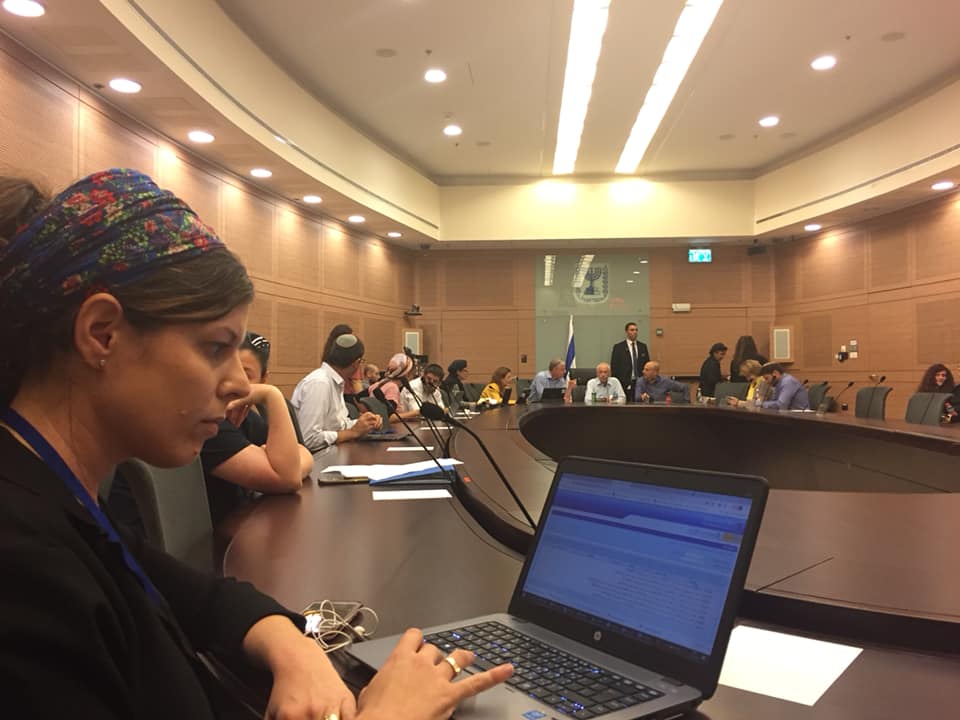
CWJ is active in Knesset committees and maintains strong connections with members of Knesset in order to promote legislation that strengthens women’s freedom in Israel. With our first-hand experience in identifying and resolving conflicts of religion and state, our expertise lends a critical voice to parliamentary discussions about women’s rights and keeps lawmakers informed of both potential legal pitfalls as well as key opportunities for positive change.
Blogs and Op-Eds
CWJ’s blogs in both English and Hebrew are naming and reframing social injustices, making them visible and therefore correctable. Our writing promotes analysis of current events through the lens of women’s rights and religious freedom.
My plea to Israeli women this Agunah Day
In an urgent plea this Agunah Day, CWJ legal department director Nitzan Caspi Shilony states in unequivocal terms: The judicial revolution currently underway is disastrous for women in Israel, and will exacerbate the harm faced by the most vulnerable women in society: agunot.
Agunot are not the only vulnerable ones in the Jewish state
All over the world, the agunah problem is a stain on the Jewish community. But in one place in the world, the problem is exacerbated to the point of a civil rights crisis: the State of Israel. Surprised? CWJ executive director Susan Weiss explains how, contrary to popular belief, the agunah problem in Israel is made worse by the state.
Four reasons the override clause should terrify women
The incoming government’s proposed override clause–which would allow the Knesset to override a Supreme Court ruling deeming legislation unconstitutional–has particularly dangerous consequences for women. Read CWJ’s executive director Susan Weiss’ breakdown of the way the Supreme Court has (sometimes hesitantly) stepped up for women’s rights in the past, and how the override clause risks damaging our already fragile protections.
Don’t vote away the basic rights of women
How many people realize how critical their votes are for protecting women’s rights? Not enough. Read Nitzan Caspi Shilony’s eye-opening piece about what’s at stake for women and religion-state issues when Israelis go their voting stations on voting day.
The Case of the NY Agunah and her Dying Father-in-Law
CWJ’s executive director Dr. Susan Weiss breaks down why a recent decision by the Rabbinate, denying burial to the father of a foreign get refuser, is dangerous for women and for our democracy.
Five misconceptions about Jewish law’s chained women
For Agunah Day, CWJ’s Executive Director Dr. Susan Weiss shatters the five most common misconceptions about the agunah problem, and how recognizing them can lead us to a real solution for women trapped in marital captivity.
Smotrich, chained wives, and the Superman effect
Much buzz has generated surrounding MK Betzalel Smotrich’s intervention in an agunah case at the Jerusalem Rabbinic Court, during which he signed as a guarantor for the woman’s financial commitment to her husband in order for him to grant the get. Thus, as reported, Smotrich “freed the agunah.”
Nitzan Caspi Shilony points out how Smotrich’s actions here are a classic example of the “Superman effect”: when someone who is part of the establishment swoops in to “save” an agunah who was only trapped because of that same establishment’s oppression of women in the first place.
Agunah Day: 3 times public outrage rescued chained women
What can Queen Esther teach us about solidarity and confronting power? To those of us fighting for agunot, Esther’s choice in calling for a public fast before she stood up to state power is not incidental. Like Esther, we see today that women’s struggle for justice directly hinges on solidarity. Three recent agunah cases demonstrate how public support plays a critical a role in women’s liberation.
Being abused won’t get you a divorce in Israel’s rabbinic court
Is domestic violence grounds for divorce in Israel’s state rabbinic courts? Most often, no. Read how the rabbinic courts’ dangerous attitude toward women who leave abusive relationships reinforces and legitimizes violence against women and compromises our democracy. A special post by CWJ’s Rachel Stomel to mark the International Day for the Elimination of Violence Against Women.
We are no longer in Shushan
Some well-intentioned agunah activists call for more sanctions, wider jurisdiction of the state rabbinic courts, a more authoritarian State Rabbinate. But what if propping up the state’s power to violate civil liberties just perpetuates the injustice that the state itself created?
Susan Weiss’ Agunah Day piece illustrates what can we learn from the parallels between ancient Shushan and modern Israel when it comes to agunot and women’s rights.
Violence against women: It is always about control
If abuse stems from control, then the most effective way to end it is to neutralize the asymmetrical power relationship that facilitates it in the first place. A recent CWJ case illustrates how one legal tool–suing recalcitrant husbands for damages in civil court–is helping women take back their power.
It’s time we call get refusal the violence that it is.
‘Let him rot in jail’ is not the answer to divorce refusers
The theocratic power that could jail a man for decades for ‘insolence’ is the very same power keeping women chained to marriage. We should be wary of this dangerous power, not cheer it on when it’s wielded against bad men. So long as the religious arm of the state theocracy is perceived as functioning diligently, aggressively, and efficiently, it obfuscates the fact that it is constructing the harm that it then alleges to save us from.
Why is the chief rabbi acting like the pope?
Israel’s Chief Rabbi’s orders to halt a burial in order to force a get from the deceased’s son has raised questions: Are we okay with the state religious establishment having the authority to violate the civil liberties of its citizens—as well as those of foreign citizens—as long as they’re harming people we don’t like?
Halakha and the State: Irreconcilable Differences
A toxic combination of power and politics distorts Jewish law into an obscene monstrosity. A look at Israel’s state rabbinic court illustrates why Israel desperately needs separation of religion and state.
Suffocating under the Rabbinate’s chokehold
An agunah, a mamzer and a pedophile walk into a rabbinic court. And only the pedophile walks away a free man.
No, this isn’t a joke. It’s a snapshot of how Israel’s war against private religious services is turning us all into collateral damage.
Agunah Day: For women in Israel, marriage is captivity
“We are all agunot” is more than a slogan, a declaration of solidarity with women refused religious divorces.
The halakhic reality is that every woman who marries in accordance with Jewish law is an agunah—held in a gilded cage of marital captivity, happy and oblivious to the legal structure that binds us.
When the judges answer to a Higher Authority
Invoking religious authority, state religious officials in Israel adjudicate, legislate, order, and detain — overreaching, and often completely ignoring, the limits of their jurisdiction while infringing on our civil liberties. They have carved out a partial theocracy for themselves.
A prying shame: The public scrutiny of get refusers
We need to stop publicly prying into the nitty gritty of people’s marriages and divorces in agunah cases. Exposing the details of marital breakdown or custody battles as a way to see who is the “good guy” implies that get refusal is a legitimate tool that is warranted under certain conditions, so it is our job to determine if those conditions have been met. It says that freedom is not a given for a woman; it is something she is entitled to only if she is found to be the more virtuous party.
#MeToo at Mount Sinai
At the most formative moment in the history of the Jewish people lies an enlightening message about consent and power. Discover how the midrash on Matan Torah—the giving of the Torah at Sinai—informs the way we can foster equality in our own communities, including the way we understand the hierarchical structuring of Jewish marriage and divorce.
More women get-refusers than men? Rabbinic courts distort the facts
CWJ attorney Nitzan Caspi Shilony breaks down the rabbinic court’s misleading report about get-refusal statistics, which present a deliberately skewed telling of the agunah problem.
Mamzer Think Tank
HaDin Ve'haDayan Law Journal
Din ve’haDayan: “The Law and its Decisor”
The HaDin Ve’haDayan journal is an academic law quarterly established in [year] by CWJ’s director Dr. Susan Weiss in conjunction with the Rackman Center at Bar Ilan University. The Hebrew-language journal publishes and critiques key decisions handed down by the Israeli state rabbinic courts in order to foster accountability and transparency about women’s treatment at the hand of these state courts. The journal has been instrumental in publicly shining a light on the structural problems in Israel’s rabbinic courts so that we can be better equipped to change them.
Prenups Meant to Solve the Problem of the Agunah: Toward Compensation, Not “Mediation“
Description text Description textDescription textDescription textDescription textDescription textDescription textDescription textDescription textDescription textDescription textDescription textDescription textDescription textDescription textDescription textDescription text.
Prenups Meant to Solve the Problem of the Agunah: Toward Compensation, Not “Mediation” >
Women, Divorce and Mamzer Status in the State of Israel
Description text Description textDescription textDescription textDescription textDescription textDescription textDescription textDescription textDescription textDescription textDescription textDescription textDescription textDescription textDescription textDescription text.
The Tort of Get Abuse: How damage litigation has changed the course of family law in Israel
CWJ’s flagship strategy of filing damage suits–torts–against get refusers in family courts has revolutionized women’s justice in Israel, both legally and socially. This extensive analysis lays out the rationale, history and practicality of torts for get refusal, including English translations of five key decisions handed down by Israeli family court judges.
The Interrogation of the Convert X by the Rabbinical Courts in Israel
The shocking story of “X”, a Jewish convert in Israel whose status as a Jew became the subject of unwarranted and seemingly unending interrogations by Israeli rabbinic courts 15 years after her conversion.
Interrogation of Convert X by the Rabbinical Courts in Israel >
Sign at Your Own Risk: The RCA Prenuptial May Prejudice the Fairness of Your Future Divorce Settlement
Various premarital agreements have been proposed to offset the power given to men over women by Jewish law in the event of divorce and to ameliorate the resulting injustices to Jewish women. Premarital agreements like the one endorsed by the Rabbinical Council of America (RCA), which expand the jurisdiction of the rabbinical courts and allow for the discretionary imposition of the suggested penalty clauses, do not adequately realign the imbalance of powers or correct the ensuing injustices. Such premarital agreements may even prejudice the interests of women in marital property, alimony or child support. This Article analyzes the premarital agreement recommended by the RCA, in contrast to other premarital agreements, and discourages its signing in favor of other agreements that better protect and promote the interests of Jewish women.
Social Media
Like, share and follow CWJ on social media:
Facebook Twitter Instagram LinkedIn
In both English and Hebrew, CWJ actively leverages social media channels to shape the cultural discourse surrounding women’s rights in Israel. We engage with tens of thousands of people worldwide, raising awareness of the problems inherent in religion-state entanglement and promoting our innovative legal solutions. Social media exposure of our cases takes the battle from the courtroom to the cultural arena, a critical component of of CWJ’s holistic strategy.
By challenging the status quo and changing hearts and minds in real time, CWJ’s social media activity directly cultivates the environment that is receptive to social change.